

Every functioning office runs on the same core set of stationery: pens, printer paper, notebooks, a stapler, paper clips, folders or binders, envelopes, tape, scissors, sticky notes, markers or highlighters, and labels. That is the baseline. For quantities, work from a simple ratio: one pack of pens per four or five staff, two to three reams of printer paper on the shelf at any time, and a spare box of staples and clips in the cupboard before the last ones run out, not after.
- Pens/pencils — one pack per 4–5 staff
- Printer paper — maintain a small reserve of reams on hand
- Notebooks/pads — one per desk, restock quarterly
- Stapler + spare staples — one per team area
- Paper clips & binder clips — one box per department
- Folders/binders — stocked to match filing volume
- Envelopes, tape, scissors, sticky notes, markers, labels — small reserve of each
Pro Tip: Printer paper, staples and ink pads cause the most downtime when they run out unannounced. Keep a visible “reorder at half-empty” marker on these three specifically.
Key Takeaways
Office essentials stationery works best when treated as a categorised, minimum-stocked system rather than a reactive list of individual purchases.
| Point | Details |
|---|---|
| Cover the core items | Pens, paper, notebooks, staplers, clips, folders, envelopes, tape, scissors, sticky notes, markers and labels are non-negotiable. |
| Standardise SKUs | One approved pen, paper weight and envelope size per office cuts mismatched reorders significantly. |
| Set minimum stock triggers | Reorder at half-empty for paper and staples to avoid downtime, not once supplies run out. |
| Match spec to visibility | Use 90 to 100gsm paper for client-facing documents; standard 80gsm for internal use. |
| Add stamps for repetitive admin | Custom stamps from Stampdesign4u replace manual marking and printed labels for routine paperwork. |
Table of Contents
- What belongs on a complete office essentials stationery checklist?
- How do you choose the right stationery for your office?
- How much stationery should an office keep in stock?
- Does stationery choice affect comfort and injury risk?
- A buyer’s view: balancing cost, quality and feedback
- Where stamps fit into a well-run stationery cupboard
- Frequently asked questions
- Sources
What belongs on a complete office essentials stationery checklist?
A proper stationery inventory splits into five practical categories: writing supplies, paper and notebooks, filing and organisation, desk tools, and mailing and presentation. Buying against categories rather than a flat list stops offices from over-ordering pens while running out of folders, which happens more often than most procurement leads admit.
Writing supplies
Ballpoint pens cover general use and last longest per unit cost. Gel pens write more smoothly and suit anyone doing extended handwriting, such as note-takers in meetings, but they dry out faster if left uncapped. Keep HB pencils and a mix of fine and broad markers for whiteboards and packaging. Highlighters matter more than people assume: colour-coding physical documents still speeds up review work, and research on handwriting suggests physical annotation supports recall better than digital equivalents for certain tasks, which is why notebooks and pens haven’t disappeared from even the most digitised offices.

Paper and notebooks
Standard printing runs on 80gsm A4. Move up to 90 to 100gsm for anything client-facing, such as proposals, letterheads or signed contracts, where the extra weight reads as more considered. Notebooks and notepads should be stocked per desk, not per department, since running out mid-meeting is a common and avoidable friction point.
Filing and organisation
Ring binders, plastic wallets and folders need to match your actual filing volume rather than a guessed number. A comprehensive stationery checklist from The Workplace Depot lists these alongside staplers and paper clips as the core organisational set every office needs, and that pairing matters: a stapler without spare staples, or a binder without matching dividers, creates the same bottleneck as having none at all.
Desk tools
Staplers, paper clips, rulers, scissors and calculators round out the desk tool category. Buy staplers rated for the volume of paper you actually staple daily, not the cheapest option on the shelf, since underpowered staplers jam constantly under load.
Mailing and presentation
Envelopes come in several formats: standard for internal post, window envelopes for invoicing (they save time by skipping address printing), and board-backed envelopes for anything that shouldn’t bend in transit. Tape and labels finish the set, and a purpose-made address stamp can do the same job as printed labels for outgoing post, faster and with no printer queue.
Pro Tip: Standardise on a single SKU per item category (one approved pen model, one paper weight, one envelope size) across the whole office. Mixed SKUs are the single biggest cause of mismatched reorders and duplicate stock.
- Writing: ballpoint/gel pens, pencils, markers, highlighters
- Paper: 80gsm standard, 90–100gsm for client documents, notepads
- Filing: ring binders, plastic wallets, folders
- Desk tools: stapler, paper clips, rulers, scissors, calculators
- Mailing: envelopes (standard, window, board-backed), tape, labels
How do you choose the right stationery for your office?
Focus procurement decisions on fit for task and standardisation across teams, not on whichever supplier catalogue happens to be open. Cheap, mismatched stock costs more over a year than a slightly pricier standardised set, because staff waste time working around tools that don’t suit the job.
Run every purchase through four criteria:
- Functionality — does the paper weight or pen tip actually suit the task (client letters need heavier paper; internal notes don’t)?
- Comfort — grip size, non-smudge ink, and weight matter for anyone writing for long stretches.
- Compatibility — does it match existing staplers, binders and refillable devices already in use?
- Sustainability — recycled paper stock and refillable pens reduce both cost and waste over time.
A useful decision rule: multiply frequency of use by client visibility. High-frequency, high-visibility items (letterhead paper, presentation folders) justify the premium spec. Low-frequency, internal-only items don’t.
Pro Tip: Before committing to a bulk order, get a sample pack from your supplier and hand it to five or six staff for a week. Real feedback on grip and smudging catches problems a spec sheet never will.
How much stationery should an office keep in stock?
Run stock through one central stationery cupboard with clear minimum levels attached to each item, not scattered supplies across individual desks. This is exactly the approach national occupational standards for office facilities management require of the role: maintaining stock to specified levels and keeping accurate records of what’s on hand.
Set reorder triggers based on supplier lead time plus a safety buffer, and automate or schedule reorders wherever your supplier allows it. Reactive purchasing, ordering only once the cupboard is empty, is the most expensive way to buy stationery because it forces last-minute, non-bulk pricing.
| Item | Suggested minimum | Reorder cadence |
|---|---|---|
| Printer paper | a few reams | Monthly, or when running low |
| Pens | 1 pack per 4–5 staff | Quarterly |
| Sticky notes | 1 pad per desk, restock quarterly | Quarterly |
| Staples | 1 spare box per stapler | As stapler stock halves |
Buying printer paper, envelopes and staples in bulk lowers unit cost and reduces how often you’re placing orders at all. For public sector buyers, the RM6299 framework offers a compliant procurement route for stationery and related consumables, which removes the need to run a separate tender for routine supplies.
Does stationery choice affect comfort and injury risk?
Choosing tools that fit the user and the task genuinely reduces fatigue and musculoskeletal strain, and this isn’t a minor detail buried in a health and safety manual. Mayo Clinic’s ergonomics guidance specifically recommends keeping frequently used items within easy reach to reduce neck, back and wrist strain, which means your stationery layout is as much an ergonomics decision as your chair or monitor height.
Practical steps: pick pens with a wider grip for anyone writing for long periods, keep the stapler and paper tray within the primary reach zone rather than across the room, and use a wrist rest if repetitive stapling or writing is part of someone’s daily role.
Pro Tip: Run a “try before you buy” trial for any high-use item before ordering a full case. OHCOW’s ergonomics guide treats worker trials as a core part of an effective ergonomic process, not an optional extra.
A buyer’s view: balancing cost, quality and feedback
I’ve watched procurement leads agonise over pens costing pennies apart while ignoring folders that fall apart within a month. The trade-off that actually matters isn’t cheap versus expensive, it’s reliable versus unreliable at the price point you’re already paying. A quick five-person trial before a bulk order, plus an informal “urgent items” list for same-day top-ups, catches most problems before they become complaints. Ask staff what’s annoying them once a quarter. You’ll hear the same three answers every time, and they’re cheap to fix.
Where stamps fit into a well-run stationery cupboard
Customised stamps cut repetitive admin time and keep paperwork consistent, which is exactly what a well-stocked stationery cupboard is meant to deliver. An address stamp replaces printed labels for outgoing post entirely. A “paid” or “date” stamp turns a manual note into a one-second action across hundreds of invoices a month. A logo stamp keeps every outgoing document, envelope, or piece of packaging carrying the same brand mark without reprinting anything.
Stampdesign4u is the alternative to reordering printed labels every month: a personalised logo stamp is a one-off purchase that keeps producing consistent branding for years, at a fraction of the ongoing cost of print runs. Office managers restocking pens and paper this quarter can add a multi-line logo and text stamp to the same order, or browse stock word stamps for routine admin marks like “received” or “paid” that need no design work at all. Order a small trial run before committing to volume, the same principle that applies to any stationery purchase, and see how much time it saves your team.
Frequently asked questions
What is office stationery, exactly? Office stationery covers the consumable and reusable items needed for daily paperwork and admin: writing tools, paper products, filing supplies, desk tools, and mailing materials.
How much stationery should a small office keep on hand? As a starting rule, keep two to three reams of printer paper, one pack of pens per four or five staff, and a spare box of staples and clips at all times, adjusting for your team’s actual usage.
Are eco-friendly stationery options worth the extra cost? Recycled paper and refillable pens often cost slightly more upfront but reduce waste and reorder frequency over time, and many suppliers now price them close to standard stock. For packaging specifically, eco-friendly packaging options are worth reviewing alongside your stationery order.
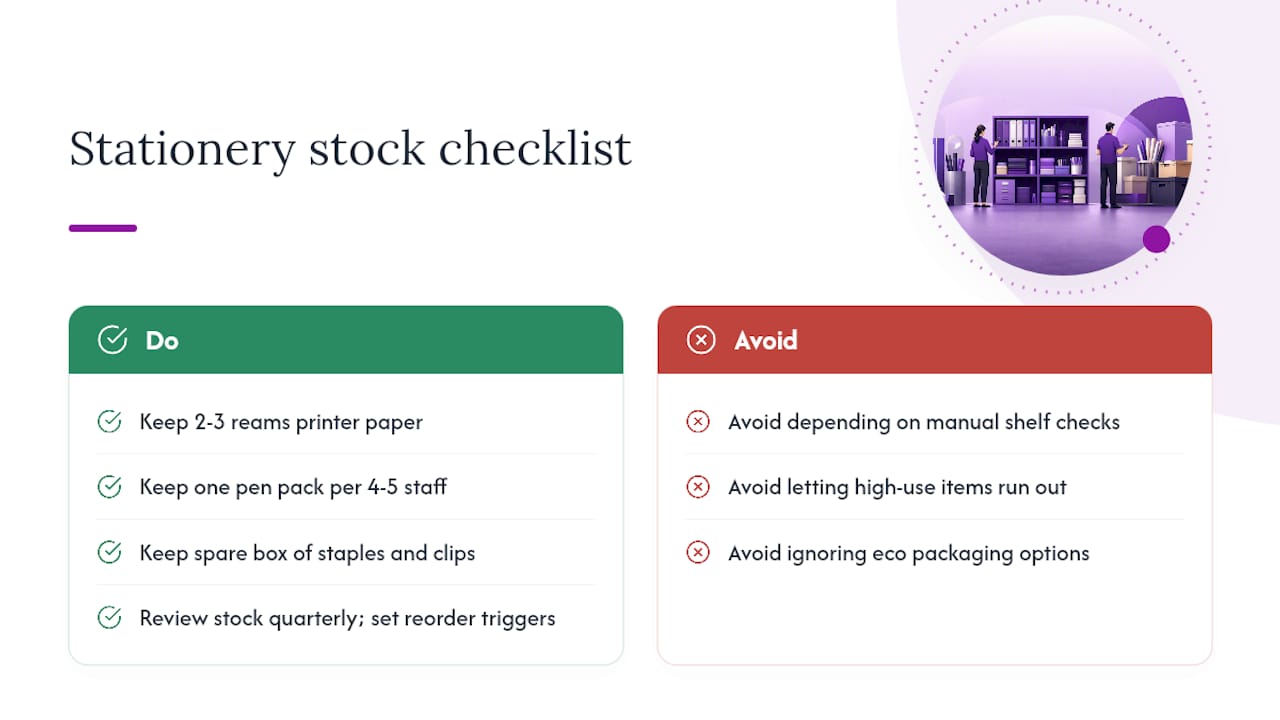
How often should stationery stock be reviewed? Review minimum stock levels quarterly, but set automated reorder triggers for high-use items like paper and staples so they never depend on someone noticing the shelf is empty.
Sources
- Stationery Items List: Office Essentials for Any Business | The Workplace Depot
- RM6299 framework agreement information — GCA
- Office ergonomics — Mayo Clinic
- Ergonomics guide — OHCOW
- Manage office facilities, resources and equipment — UK National Occupational Standards