

TL;DR:
- A sequential numbering stamp automatically prints unique, incremental numbers on documents, improving efficiency and accuracy. Bates numbering adds standardized prefixes and zero-padding for legal and audit purposes, ensuring document traceability. Proper setup, maintenance, and appropriate choice between manual and automatic models optimize document processing workflows.
A sequential numbering stamp is a self-inking mechanical device that automatically prints a new, incrementally higher number onto a document with each press, eliminating the need for manual counting or handwriting. Businesses across finance, logistics, and event management rely on this tool to organise invoices, tickets, receipts, and stock records with speed and consistency. Brands such as Reiner and Trodat have built entire product lines around this function, producing devices that can number up to 999,999 documents without a single manual adjustment. The core benefit is straightforward: every document receives a unique, traceable identifier the moment it is stamped.
How do sequential numbering stamps work?
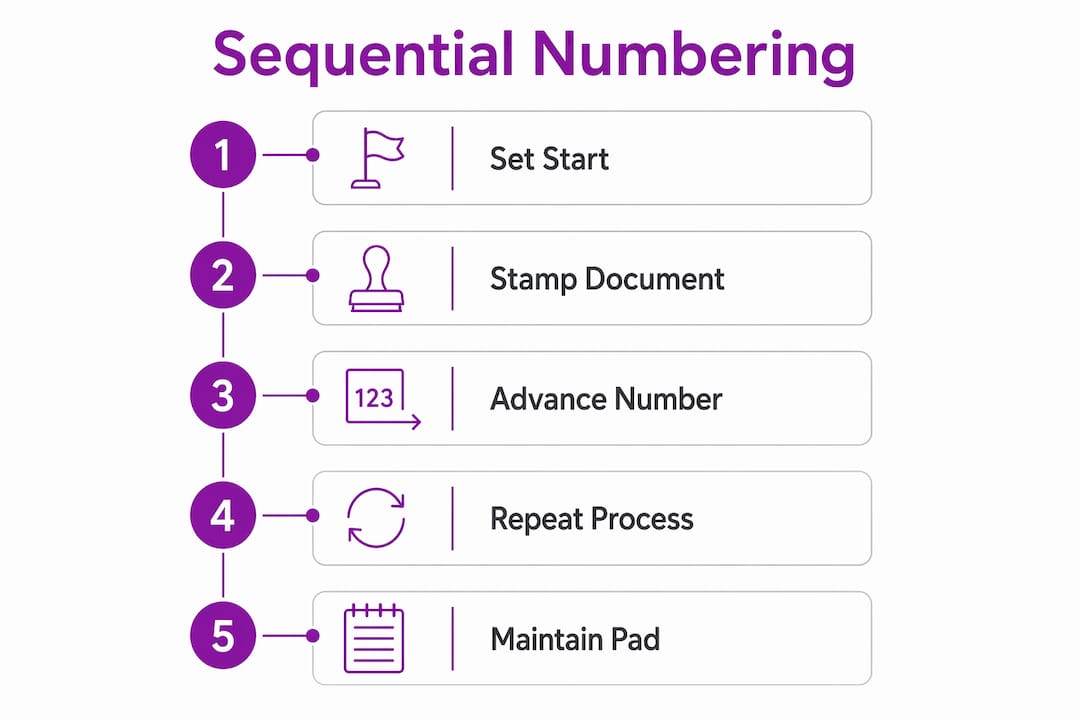
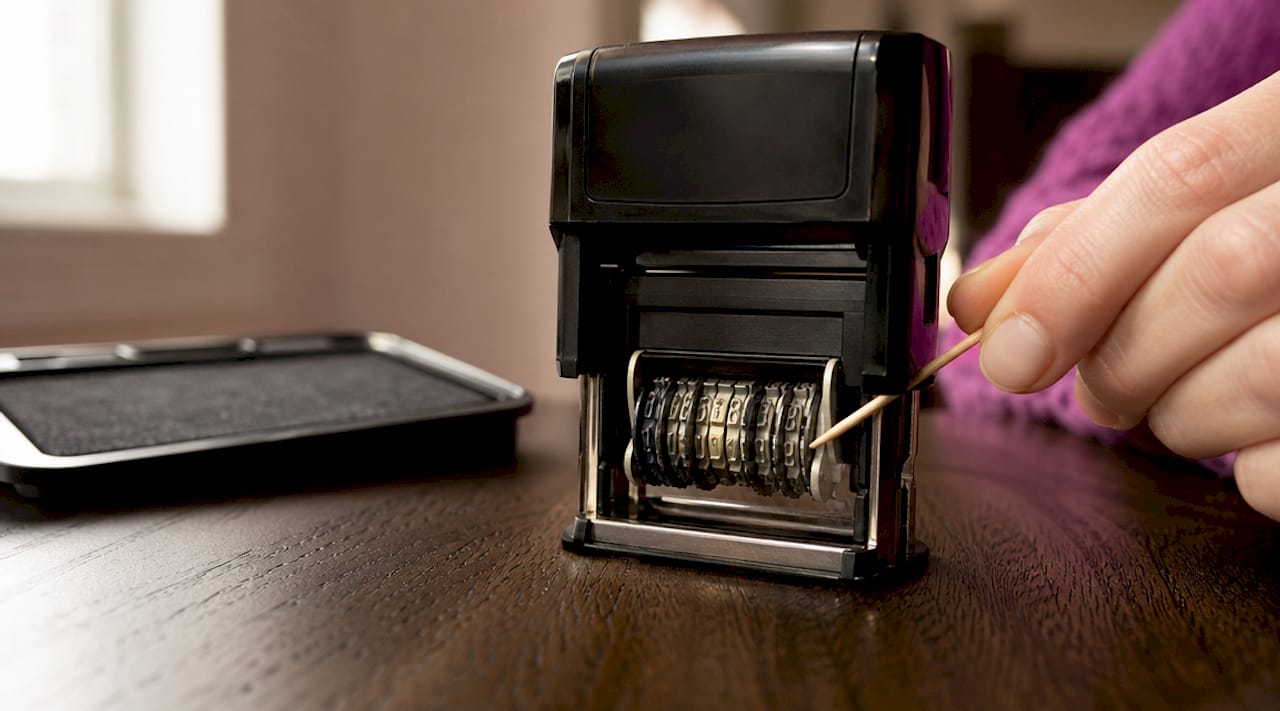
An automatic numbering machine is a self-inking device that uses six metallic numeral wheels to advance a unique number after each press, covering sequences up to 999,999 without manual adjustment. Each wheel rotates independently, carrying digits from 0 to 9, and the mechanism advances the sequence automatically when the stamp face contacts the document. This means a clerk processing 200 invoices in an afternoon never touches a pen or resets a counter.
Most devices offer three numbering modes: consecutive (each press advances by one), duplicate (the same number prints twice before advancing), and triplicate (three identical impressions before advancing). Duplicate and triplicate modes are particularly useful for carbon-copy receipts or multi-part forms where each copy of the same transaction must carry the same reference number.
The distinction between manual and automatic models matters for volume. Manual stamps, such as the Acorn 20MB600, require the user to set the starting number using a stylus to rotate each wheel individually. Automatic models from Reiner advance the number mechanically with every impression, making them the preferred sequential numbering tool for high-throughput environments. Both types are self-inking, meaning the ink pad is built into the device and re-inks the face after each press.
- Consecutive mode: advances by one with every stamp, ideal for invoices and purchase orders
- Duplicate mode: prints the same number twice before advancing, suited to two-part forms
- Triplicate mode: three identical impressions before advancing, used for three-part carbon documents
- Digit capacity: most standard models offer six digits, supporting sequences from 000001 to 999999
- Start number: set manually using a stylus on the numeral wheels before first use
Pro Tip: Before stamping a large batch, press the stamp onto scrap paper three times to confirm the starting number is correct and the ink is evenly distributed.
What is Bates numbering and how does it differ?
Bates numbering is a specialised form of sequential stamping used in legal, medical, and forensic documents to assign unique, unambiguous identifiers that include prefixes, zero-padding, and suffixes for contextual clarity. The term originates from the Bates Manufacturing Company, whose numbering machines became standard equipment in American law offices during the early twentieth century. Today the practice is universal in litigation discovery, audit trails, and regulatory submissions.
The difference between standard sequential numbering and Bates numbering lies in structure and intent. A standard sequential numbering stamp simply prints the next number in a series. A Bates stamp prints a formatted identifier such as ACME000001, where “ACME” is the prefix identifying the producing party and “000001” is the zero-padded sequence number. Legal professionals rely on this format because it makes every document citeable during discovery, preventing disputes caused by ambiguous references.
| Feature | Standard sequential stamp | Bates numbering stamp |
|---|---|---|
| Output format | Plain number (e.g., 000123) | Prefix + number + suffix (e.g., ACME000123) |
| Primary use | Invoices, tickets, stock records | Legal discovery, medical records, audits |
| Zero-padding | Optional | Required for consistent sorting |
| Placement convention | Flexible | Typically bottom-right of each page |
| Traceability scope | Internal document control | Cross-party, court-admissible identification |
Bates numbering standards require uniform placement on documents, consistent prefixing, and zero-padding to produce globally traceable identifiers that survive printing, scanning, and file format conversions. This level of rigour is why legal teams treat sequential numbering as a matter of evidentiary integrity, not merely administrative tidiness.
Pro Tip: When setting up a Bates stamp for a new matter, agree on the prefix format with all parties before stamping begins. Changing a prefix mid-production creates gaps that courts and opposing counsel will question.
What are the practical applications and benefits of numbering stamps?
Businesses that switch from handwritten numbering to a sequential numbering system report 50 to 80% greater operational efficiency in document processing, with measurable reductions in errors on invoices and inventory records. That figure reflects a genuine operational shift. When a warehouse operative no longer writes reference numbers by hand, the risk of transposing digits or duplicating a number drops to near zero.
The range of numbering stamp applications spans almost every sector that handles physical documents. Finance teams stamp invoices and payment vouchers. Logistics operators number despatch notes and goods-received forms. Event managers number tickets and wristbands. Retailers mark stock cards and cash sales slips. Each use case shares the same underlying requirement: a unique, sequential identifier that allows any document to be located, cross-referenced, or audited quickly.
Here are the most common document types that benefit from a sequential numbering tool:
- Invoices and purchase orders — sequential numbers prevent duplicate payments and simplify reconciliation
- Event tickets and wristbands — numbered tickets deter counterfeiting and enable attendance tracking
- Despatch notes and delivery receipts — sequential references link outgoing goods to customer orders
- Stock cards and inventory sheets — numbered records support cycle counts and discrepancy investigations
- Bank receipts and cash sales slips — stamps are preferred over computer printing for irregular-sized or carbon-copy documents, providing mobility and flexibility
The traceability benefit extends beyond day-to-day operations. During a VAT inspection or an internal audit, a complete, unbroken sequence of numbered documents demonstrates procedural compliance far more convincingly than a spreadsheet. A missing number in a sequence is immediately visible, prompting investigation rather than allowing a gap to go unnoticed. For a deeper look at how stamps fit into broader office workflows, the guide on types of business stamps covers the full range of tools available.
Common usage tips and pitfalls with numbering stamps
Mechanical numbering stamps require manual setting of the wheels with a stylus, and users frequently mismanage leading zeros or visible digit counts, producing formatting errors that compromise numbering clarity. This is the single most common complaint from first-time users, and it is entirely avoidable with a methodical setup process.
The most frequent mistakes and how to prevent them:
- Incorrect start number: always rotate each wheel individually with the stylus and verify the full number before the first impression
- Unwanted leading zeros: if your sequence starts at 1 rather than 000001, adjust the digit visibility setting so only the active digits display
- Faded impressions: maintaining the self-inking pad and cleaning the numeric wheels regularly prevents faded marks and mechanical failures
- Skipped numbers: never press the stamp without a document beneath it; dry impressions can advance the counter without producing a usable record
- Ink contamination: store stamps face-down on a clean surface or in their original case to prevent dust from clogging the ink pad
Pro Tip: Re-ink the pad before it runs completely dry rather than waiting for impressions to fade. Topping up a pad that still has residual ink produces a more even result than saturating a dry pad.
Stamps are also the practical choice when a printer is simply not available or not suitable. For bank receipts, tickets, and carbon-copy forms, the portability of a handheld numbering stamp makes it indispensable in ways that a networked printer cannot replicate.
How to choose the right numbering stamp for your needs
Selecting the right sequential numbering tool requires matching the device’s specifications to the volume, document type, and budget of the intended use. The key factors are durability, ink type, digit capacity, and the numbering advancement mode the workflow demands. Choosing between manual and automatic depends primarily on volume and document type, with automatic models justified when daily stamping runs into the hundreds.
| Factor | Manual stamp (e.g., Acorn 20MB600) | Automatic stamp (e.g., Reiner series) |
|---|---|---|
| Best for | Low to medium volume, occasional use | High volume, daily production runs |
| Start number setup | Manual wheel adjustment with stylus | Pre-set or electronic configuration |
| Cost | Lower upfront cost | Higher upfront, lower per-impression cost |
| Portability | Compact and lightweight | Slightly larger, still portable |
| Digit capacity | Typically 6 digits | 6 digits, some models offer more |
Beyond the manual versus automatic decision, consider these selection criteria:
- Ink type: oil-based inks suit standard paper; waterproof inks are necessary for glossy or coated stock
- Digit capacity: six digits covers most business needs; legal or archival applications may require more
- Numbering modes: confirm the device supports consecutive, duplicate, or triplicate modes as your workflow requires
- Document size: ensure the stamp face fits the designated space on your forms without obscuring adjacent text
- Replacement pads: check that re-inking pads or cartridges are readily available for the model you choose
For businesses exploring the full range of stamp options beyond numbering, the overview of rubber stamp varieties provides useful context on how numbering stamps sit within a broader document management toolkit. Sequential numbering for specific applications such as parking ticket management also illustrates how the same principles apply across very different operational contexts.
Key takeaways
A sequential numbering stamp is the most reliable, low-cost method for assigning unique, traceable identifiers to physical documents at volume, with automatic models handling up to 999,999 impressions without manual intervention.
| Point | Details |
|---|---|
| Core function | Automatically advances a printed number with each press, removing manual counting entirely. |
| Bates numbering distinction | Adds prefixes and zero-padding for legal-grade, court-admissible document identification. |
| Efficiency gain | Businesses report 50 to 80% greater efficiency over manual numbering in invoice and inventory workflows. |
| Maintenance matters | Regular pad re-inking and wheel cleaning prevents faded impressions and mechanical failures. |
| Selection criteria | Match digit capacity, ink type, and advancement mode to your document volume and type. |
Why sequential numbering stamps deserve more credit than they get
I have worked with stamp products long enough to notice that numbering stamps are consistently underestimated. Most buyers treat them as a commodity purchase, pick the cheapest model, and then wonder why impressions fade after three months or why the sequence resets unexpectedly. The reality is that the mechanical quality of the numeral wheels varies considerably between manufacturers, and that difference becomes obvious only after a few thousand impressions.
What I find genuinely interesting is the gap between how legal teams use Bates stamps and how most small businesses use standard numbering stamps. Legal professionals treat sequential numbering as a matter of evidentiary integrity, specifying prefix formats, zero-padding conventions, and placement rules before a single document is stamped. Most small business owners, by contrast, start stamping invoices without a defined format and then face reconciliation problems six months later when the sequence contains gaps or inconsistencies.
The practical lesson is to treat your numbering stamp setup the same way a legal team would: define the format, set the start number deliberately, and document the convention so that anyone covering the role can continue the sequence correctly. That discipline costs nothing and prevents a significant amount of administrative rework. Combining a manual model for low-volume tasks with an automatic device for high-throughput runs is also worth considering. The two tools complement each other rather than compete, and the investment in a quality automatic model pays back quickly in time saved.
— Steven
Explore numbering stamps at Stampdesign4u
Stampdesign4u stocks a range of stamps suited to sequential numbering and broader document management needs, from compact self-inking models to fully customisable designs for business branding.
The Trodat Printy 4927 is a high-quality, customisable rubber stamp popular with businesses that need consistent, professional impressions across large document volumes. For loyalty programmes and repeat-use applications, the Traxx 9021 loyalty stamp offers durability and versatility in a compact format. Both products are available with custom text and design options, making it straightforward to align your stamp with your existing document conventions.
FAQ
What is a sequential numbering stamp used for?
A sequential numbering stamp is used to print automatically advancing numbers on documents such as invoices, tickets, receipts, and stock records. Each press produces the next number in the sequence, creating a traceable, unbroken reference system.
How many numbers can a standard numbering stamp produce?
A standard six-wheel numbering stamp covers sequences from 000001 to 999,999, providing up to 999,999 unique impressions before the sequence needs resetting.
What is the difference between a numbering stamp and a Bates stamp?
A standard numbering stamp prints a plain sequential number, while a Bates stamp adds a prefix and zero-padded format (for example, ACME000001) to create legally citeable identifiers used in litigation discovery and audits.
How do you set the start number on a mechanical numbering stamp?
Use the supplied stylus to rotate each numeral wheel individually to the desired digit, then verify the full number by pressing the stamp onto scrap paper before beginning production stamping.
When should you choose an automatic numbering stamp over a manual one?
Choose an automatic model when daily stamping volumes run into the hundreds, as the mechanical advancement removes the risk of manual resetting errors and significantly reduces processing time.