

A commemorative stamp design is a limited-edition postage stamp issued by Royal Mail to mark significant events, anniversaries, people, or cultural achievements. Unlike everyday stamps, commemoratives function as miniature works of art. They are produced in finite quantities, rarely reprinted once initial stock sells out, and are not usually barcoded, which sets them apart from standard definitive stamps used for routine postage.
Key characteristics of UK commemorative stamp designs:
- Must display the monarch’s head and clearly show the face value
- Issued in limited runs, with no guarantee of reprinting
- Designed by commissioned artists selected through a competitive pitch process
- Reviewed by the Stamp Advisory Committee (SAC) before royal approval
- Cover themes ranging from history and science to popular culture and the arts
How do commemorative stamps differ from definitive stamps?
The distinction comes down to purpose and lifespan. Definitive stamps handle everyday postal needs. They stay in circulation indefinitely, get reprinted as required, and carry straightforward designs, typically the monarch’s portrait or a simple motif. Commemoratives exist for a fixed window, tied to a specific theme or occasion.
| Feature | Commemorative stamps | Definitive stamps |
|---|---|---|
| Purpose | Celebrate events, people, culture | Everyday postage use |
| Availability | Limited run, rarely reprinted | Reprinted as needed, long-term |
| Design style | Pictorial, thematic, artistic | Simple, consistent |
| Barcoding | Usually not barcoded | Barcoded for postal sorting |
| Collector appeal | High, sought after by philatelists | Lower, widely available |
| Issuance frequency | 13–15 sets annually | Continuous |
Collectors treat commemoratives as a distinct category precisely because their limited reprinting creates a defined philatelic lifecycle, as detailed in the report on how britai keis pinigus ir pašto ženklus po karalienės mirties. Once a set is gone, it is gone.
How are UK commemorative stamp designs chosen and created?
Royal Mail drives the theme selection process, researching subjects up to five years in advance. Themes must meet clear criteria: anniversaries in multiples of 50 years, major national events, or subjects reflecting British contributions to the arts and sciences. The organisation receives hundreds of public suggestions each year, but final decisions rest with Royal Mail’s internal team.
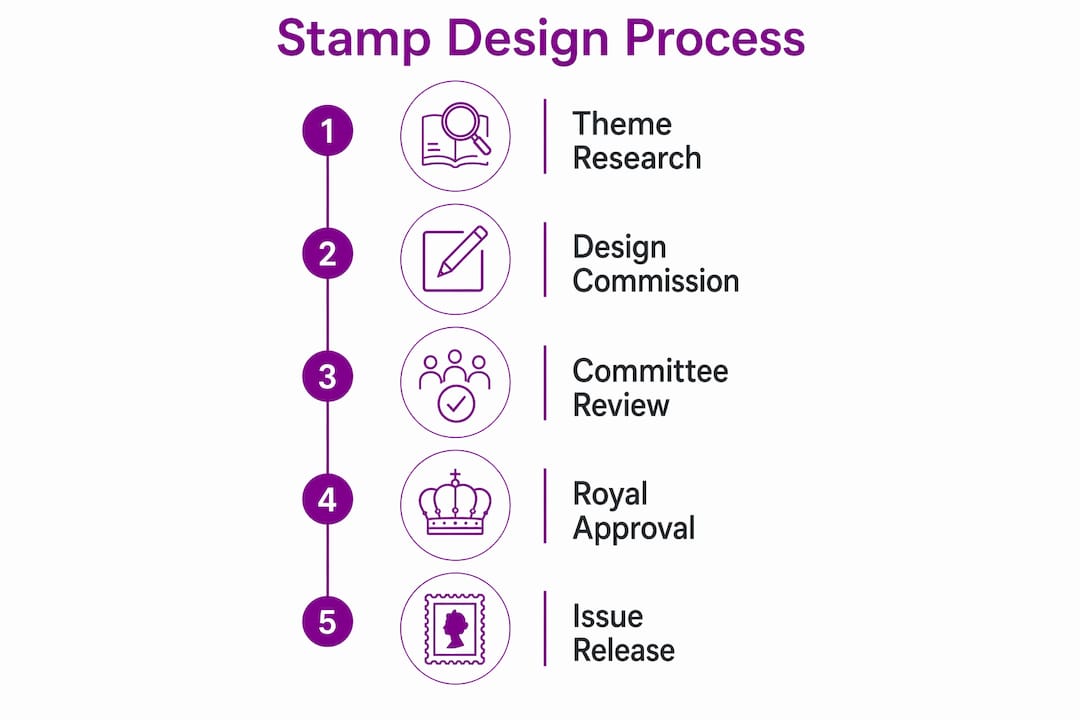
Once themes are confirmed, the custom stamp design process begins with a democratic commissioning approach. Multiple agencies and specialist artists are invited to pitch for each theme, rather than relying on a fixed roster. This broadens creative diversity and produces designs with genuine thematic authenticity.

The Stamp Advisory Committee then reviews competing designs. The SAC draws on designers, philatelists, academics, and government appointees to assess artistic suitability and technical quality. Its recommendations are not binding on Royal Mail, but they carry significant weight in shaping the final shortlist.
The full design process spans 1–2 years. Royal approval is sought six to eight months before the planned issue date, with the monarch reviewing final design proofs, known as “essays,” before production begins.
Pro Tip: Legibility at miniature scale is the single hardest challenge in commemorative stamp design. Artists typically produce original artwork at a much larger size, then reduce it. Details that look clear at A4 size can disappear entirely at stamp dimensions, so every design element must earn its place.
Key stages in the process:
- Theme research and shortlisting by Royal Mail
- Open commissioning of multiple artists per theme
- SAC review and design shortlisting
- Royal approval of final essays
- Production and print run
Why do commemorative stamps matter beyond the post?
Royal Mail issues approximately 13–15 sets of commemorative stamps each year, covering history, science, sport, and popular culture. That volume reflects a deliberate policy: commemoratives serve as miniature galleries of British life, not just postal instruments.
They record societal shifts. A set celebrating women in science, or one marking a centenary of a cultural movement, becomes a physical document of what the country chose to honour at a particular moment. For collectors, that narrative value compounds over time.

| Theme category | Example subjects |
|---|---|
| History and heritage | Battles, royal milestones, national institutions |
| Arts and literature | Authors, painters, theatrical traditions |
| Science and innovation | Discoveries, inventors, engineering achievements |
| Nature and environment | British wildlife, landscapes, conservation |
| Popular culture | Television, music, sport |
| International events | Commonwealth, Olympic participation |
The significance of stamp design extends to public engagement. Commemoratives reach people who would never visit a gallery or museum, placing original commissioned artwork directly into everyday hands.
How has commemorative stamp design evolved in the UK?
Britain’s first picture stamp appeared in 1924, celebrating the British Empire Exhibition at Wembley. That set established the commemorative format, though issues remained infrequent for the following four decades.
The decisive shift came in 1964, when Postmaster General Tony Benn expanded the commemorative programme substantially. His reforms moved British stamps away from monarch-centric imagery toward diverse pictorial themes, responding to growing collector demand and aligning with international standards. Designer David Gentleman produced the first modern commemorative designs under this new approach, setting a visual standard that influenced British philately for generations.
Key milestones in the history of commemorative stamps:
- 1840: The Penny Black, the world’s first adhesive postage stamp, establishes the format
- 1924: Britain’s first commemorative picture stamp, marking the British Empire Exhibition
- 1964: Tony Benn’s reforms expand annual commemorative issues and broaden thematic scope
- 1960s: David Gentleman designs the first modern UK commemoratives, shifting aesthetic standards
- 1968: The Stamp Advisory Committee is formally reconstituted under Post Office appointment
- Present: Royal Mail issues multiple commemorative sets annually across a wide range of themes
| Period | Design approach | Key change |
|---|---|---|
| Pre-1924 | Monarch portrait only | No pictorial themes |
| 1924–1964 | Occasional commemoratives | Limited thematic scope |
| 1964 onwards | Regular pictorial issues | Diverse themes, open commissioning |
What printing techniques do commemorative stamps use?
Commemorative stamps use more specialised production methods than definitive stamps, reflecting their status as collectible art. Lithography and photogravure are the two most common printing processes. Lithography produces flat, even colour across large areas and suits photographic or painterly imagery. Photogravure, which etches an image into a cylinder before inking, delivers fine tonal gradation and is well suited to portraits and detailed illustrations.
Beyond standard printing, die-cutting and special inks appear on selected issues to enhance visual impact. Foil stamping, embossing, and phosphor bands (which trigger automated postal sorting equipment) are also used. The phosphor coating is applied even to non-barcoded commemoratives, maintaining postal functionality without compromising the design surface.
Scale remains the central technical constraint. Artwork originates at a much larger size and must be reduced without losing clarity, which demands close collaboration between the artist and the print production team throughout the process.
Explore custom stamp design with Stampdesign4u
Collectors and businesses looking to explore the world of custom stamp design will find a practical range of options at Stampdesign4u. From personalised logo stamps to packaging solutions, the platform offers accessible design tools for anyone wanting to create something distinctive. Browse the full range of personalised packaging stamps to get started.
Key takeaways
Commemorative stamp design in the UK combines artistic commissioning, regulatory oversight, and cultural intent to produce limited-edition issues that serve collectors and the public alike.
| Point | Details |
|---|---|
| Definition and purpose | Commemorative stamps are limited-edition Royal Mail issues marking events, anniversaries, and cultural achievements. |
| Design process duration | The full design process spans 1–2 years, with royal approval sought six to eight months before issue. |
| Annual output | Royal Mail issues approximately 13–15 sets of commemorative stamps each year. |
| Collector distinction | Commemoratives are rarely reprinted once initial stock sells, creating a defined philatelic lifecycle. |
| Historical turning point | Tony Benn’s 1964 reforms and David Gentleman’s designs shifted UK stamps toward diverse pictorial themes. |