

TL;DR:
- A date received stamp records the exact date when documents or goods arrive at an organization, strengthening audit trails and legal compliance. It should be used alongside signatures and a goods received note to provide strong verification. Digital equivalents like electronic timestamps offer legally recognized, tamper-proof proof of receipt under UK law.
A date received stamp is a physical or digital marking device that records the exact date on which documents or goods are formally received by an organisation or individual. Known in professional settings as a “received” stamp or received-by stamp, it forms a critical part of audit trails, legal compliance, and day-to-day document management. Under UK law, including the Companies Act 2006 and HMRC regulations, accurately dating records is not optional. Whether you run a small business, manage an office, or handle supplier invoices at home, understanding how this tool works protects you from costly disputes and compliance failures.
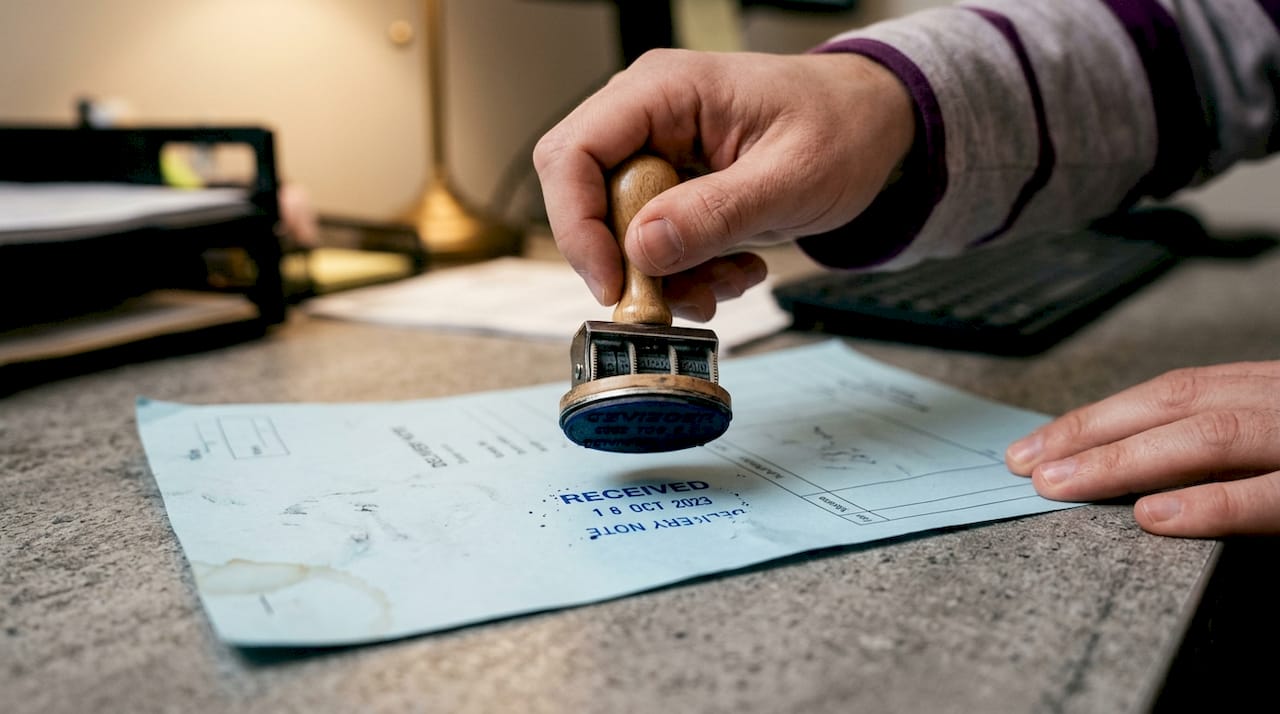
What is a date received stamp and why does it matter?
A date received stamp is defined as a tool, either physical or digital, that imprints or records the date on which a document or item formally enters an organisation. The stamp typically prints the word “RECEIVED” alongside the current date, often in red or blue ink. Self-inking date stamps are the most common format in office environments because they require no separate ink pad and produce consistent impressions.
The received date is distinct from the document’s own date. An invoice issued on 1 march 2026 may not arrive until 15 march 2026. The date received stamp captures that arrival date, not the invoice date. Separating these two dates prevents misfiling and avoids audit failures caused by timeline confusion.
Businesses that skip this step expose themselves to real risk. Experts warn that undated documents create blind spots in timelines, which can cause costly disputes and audit failures. A single missing date on a supplier invoice can delay payment processing, invalidate a warranty claim, or weaken a legal defence.
How is a date received stamp used in administrative and business workflows?
The standard procedure for receiving documents or goods follows a clear sequence. Each step builds on the last, and the date received stamp sits at the centre of the process.
- Receive the document or delivery. The item arrives at your premises or inbox. Physical deliveries come with a delivery note; digital documents arrive by email or upload.
- Inspect the item. Check quantities, condition, and any visible damage before accepting the delivery.
- Match to the purchase order. Compare the delivery note or invoice against the original purchase order to confirm what was ordered and what has arrived.
- Stamp and sign the delivery note. Apply the date received stamp and add a staff signature. This combination of stamp and signature forms the core of a verifiable audit trail.
- Raise or update the Goods Received Note (GRN). The GRN records quantities received and their condition. It links the delivery note to the purchase order and triggers payment processing.
- File the stamped document. Store the stamped delivery note, invoice, and GRN together for future reference.
Documents commonly stamped include delivery notes, supplier invoices, internal correspondence, and contracts. The Trodat 4850 is a widely used self-inking option that prints “RECEIVED” with the date in a single impression.
A critical point that many businesses miss: a date received stamp alone is not sufficient evidence of goods receipt. It must be used alongside a completed GRN that confirms quantities and condition. Without that cross-reference, the stamp provides only weak evidence in a dispute.
Pro Tip: Assign one person per shift the responsibility for stamping and signing incoming documents. Inconsistent stamping across staff members is the most common cause of gaps in audit trails.
What legal and compliance significance does a date received stamp hold in the UK?
UK law makes accurate dating of records a legal requirement, not a best practice. The consequences of getting it wrong are significant.
Key legal obligations include:
- Companies Act 2006: Requires businesses to keep accounting records for at least six years. Undated records risk fines or invalidation in disputes.
- HMRC regulations: Accounting and tax records must be retained for six years from the end of the relevant accounting period.
- Limitation Act 1980: Contracts must be kept for six years after they expire. An undated contract creates uncertainty about when that six-year clock starts.
- Payroll records: Must be retained for three years after the end of the relevant tax year.
- UK GDPR: Requires that personal data is kept only for as long as necessary. A precise received date triggers the correct retention and disposal schedule.
“Businesses often over-retain records, risking GDPR violations. A clearly documented policy for dating and disposing of documents is essential. UK GDPR requires personal data retention only for as long as necessary, making precise timestamps important to trigger proper retention and disposal.”
UK GDPR and retention policies interact directly with date received stamps. If you cannot prove when a document arrived, you cannot prove when the retention clock started. That ambiguity can result in either premature disposal, which destroys evidence, or over-retention, which breaches data protection law.
Undated records also weaken your position in contract disputes. If a supplier claims you received an invoice on 1 february but your records show no received date, you have no evidence to counter that claim. A stamped and signed document closes that gap immediately.
What are digital equivalents and modern innovations of the date received stamp?
Digital workflows require a digital equivalent of the physical received stamp. The recognised standard under EU and UK law is the qualified electronic timestamp, defined under the eIDAS regulation. A qualified electronic timestamp provides tamper-evident, legally recognised proof of the date and time a document was received or created. It reduces disputes over receipt timing in litigation and regulatory reviews.
The table below compares physical and digital date received methods across key criteria.
| Criterion | Physical date received stamp | Qualified electronic timestamp |
|---|---|---|
| Legal recognition in UK | Yes, as part of signed records | Yes, under eIDAS and UK law |
| Tamper evidence | Low (ink can be altered) | High (cryptographically secured) |
| Audit trail strength | Moderate, requires GRN cross-reference | Strong, immutable record |
| Cost | Low (one-off stamp purchase) | Ongoing software or service cost |
| Suitable for | Physical documents, delivery notes | Digital invoices, email records |
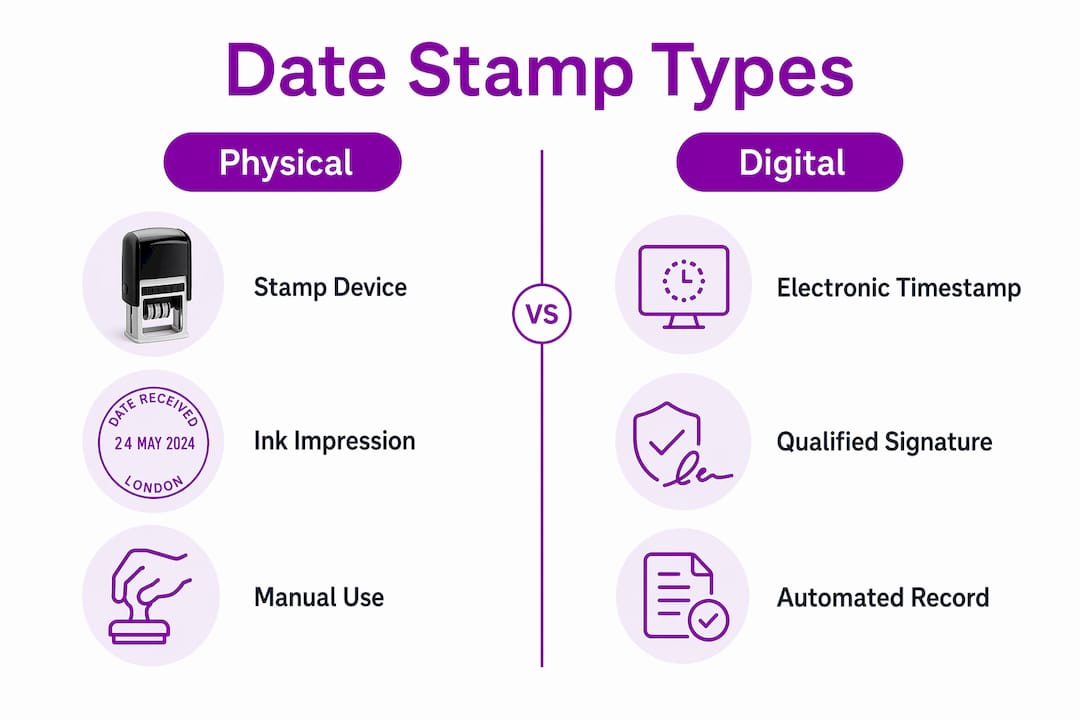
Physical stamps become a flat image when documents are scanned. That image alone does not satisfy strict legal requirements for digitised records. Automated digital timestamping by a document management system is necessary to maintain legal integrity when converting physical records to digital formats.
Pro Tip: When scanning stamped documents, configure your document management system to apply an automatic metadata timestamp at the point of upload. This creates a dual record: the visible stamp image and an immutable digital timestamp.
How to choose and effectively use a date received stamp for your needs
Choosing the right received stamp depends on your volume of documents, your workflow, and your compliance requirements. The main types available are:
- Self-inking date stamps: The most practical option for regular use. The ink pad is built into the stamp mechanism and re-inks automatically with each impression. The Trodat 4850 is a standard example, printing “RECEIVED” and the date in a single action.
- Manual rubber stamps with a separate ink pad: Lower cost upfront, but slower and less consistent. Suitable for very low-volume use.
- Customised stamps: Allow you to add your business name, logo, or additional fields such as “Checked by” or “Approved.” The Trodat Printy 4912 supports up to five lines of custom text, making it a practical choice for businesses that want branded received stamps.
When selecting a stamp, consider these factors:
- Volume: High-volume offices need self-inking mechanisms that last thousands of impressions without re-inking.
- Ink colour: Red ink is standard for received stamps as it stands out clearly on white paper. Blue is also widely used.
- Date format: Choose a stamp with a date band that matches your preferred format, such as DD/MM/YYYY, which is standard in the UK.
- Customisation: If your workflow requires additional fields beyond the date, a customisable stamp saves time compared to writing those fields by hand.
Integrating the stamp into daily routines is as important as choosing the right model. Place the stamp at the point of receipt, not at a later processing stage. A document stamped two days after arrival records the wrong date and undermines the entire purpose of the tool. Consistent use, combined with a signed GRN and a clear filing system, produces an audit trail that holds up under scrutiny.
Key takeaways
A date received stamp is the single most cost-effective tool for creating a legally defensible, time-accurate record of document and goods receipt in any UK business or administrative setting.
| Point | Details |
|---|---|
| Definition and purpose | A received stamp records the exact arrival date of documents or goods, separate from the document’s own date. |
| Legal obligation | Companies Act 2006 and HMRC require records kept for six years; undated documents risk fines and disputes. |
| Workflow integration | Stamp and sign at the point of receipt, then cross-reference with a GRN to create a complete audit trail. |
| Digital equivalents | Qualified electronic timestamps under eIDAS provide legally recognised, tamper-evident digital alternatives. |
| Stamp selection | Self-inking and customisable stamps suit most business needs; match the stamp type to your document volume and compliance requirements. |
Why I think most businesses underestimate this small tool
After years of working with document management processes, the pattern I see most often is this: businesses invest in expensive accounting software and compliance consultants, then undermine everything with inconsistent stamping. A staff member forgets to stamp an invoice. Another stamps it two days late. A third confuses the invoice date with the received date and files accordingly. The audit trail falls apart at the most basic level.
The received date and the document date are not the same thing. Confusing the two is one of the most common causes of audit failure I have encountered. It sounds obvious when stated plainly, but in a busy office, it happens constantly. Training staff on this single distinction pays dividends that no software upgrade can replicate.
The other mistake I see regularly is treating the stamp as a standalone record. A stamp without a corresponding GRN and purchase order match is weak evidence. It proves a document arrived, but not what was in it, whether it matched the order, or whether it was accepted. The stamp is the starting point, not the finish line.
My recommendation is straightforward. Standardise your stamping procedure in writing. Assign responsibility to named individuals. Review your stamped records quarterly to catch gaps before an audit does. And if you are moving to digital workflows, do not assume that scanning a stamped document is sufficient. Apply automated timestamping at the point of upload. That combination of physical and digital records is the most defensible position you can take.
— Steven
Stampdesign4u’s date received stamps for your document workflow
Stampdesign4u offers a range of date received stamps suited to individuals, small businesses, and administrative teams. The Trodat Printy 4912 supports up to five lines of custom text, making it straightforward to add your business name, a signature line, or a reference field alongside the received date.
For ready-to-use options, the date stamps collection includes self-inking models that print clearly on delivery notes, invoices, and supplier correspondence. Each stamp is built for consistent daily use and produces impressions that hold up in scanned records and audit reviews. Customisation options mean your stamp works exactly as your workflow requires, without compromise.
FAQ
What does a date received stamp mean on a document?
A date received stamp records the exact date on which a document formally arrived at an organisation. It is distinct from the document’s own issue date, such as an invoice date, and creates a verifiable record for audit and compliance purposes.
What is a received-by stamp used for?
A received-by stamp confirms both the date of receipt and, when signed, the identity of the person who accepted the document or delivery. It is used on delivery notes, invoices, and contracts to support purchase order reconciliation and payment processing.
How long must stamped records be kept under UK law?
Under the Companies Act 2006 and HMRC regulations, accounting records must be kept for six years. Payroll records must be retained for three years after the relevant tax year end. UK GDPR requires that records containing personal data are disposed of once the retention period expires.
Can a digital timestamp replace a physical date received stamp?
A qualified electronic timestamp under eIDAS is the legally recognised digital equivalent of a physical received stamp. It provides tamper-evident proof of receipt time and date, and is accepted in UK litigation and regulatory reviews.
What is the difference between a date stamp and a date received stamp?
A date stamp simply imprints the current date. A date received stamp includes the word “RECEIVED” alongside the date, making its purpose explicit on the document. The received stamp is the standard tool for document intake workflows in business and administrative settings.